Polonnaruwa is one of Sri Lanka’s great ancient capitals and one of the most rewarding archaeological cities for travelers because its major monuments can be explored within a relatively compact landscape. UNESCO identifies Polonnaruwa as Sri Lanka’s second capital after Anuradhapura and highlights the monumental garden-city developed under King Parakramabahu I in the twelfth century.
The city combines royal buildings, Buddhist monasteries, Hindu monuments, reservoirs and some of the island’s finest surviving stone sculpture. Cycling between sites is popular, but understanding the historical sequence is just as important as covering distance.
Why Polonnaruwa became a capital
After Anuradhapura declined, political power shifted to Polonnaruwa. The city developed under different rulers, including a period of Chola control and later major Sinhala royal expansion.
This mixed history explains why both Buddhist and Hindu monuments appear within the archaeological zone.
UNESCO World Heritage status
The Ancient City of Polonnaruwa was inscribed on the World Heritage List in 1982. UNESCO highlights its royal and religious monuments and the twelfth-century garden-city associated with Parakramabahu I.
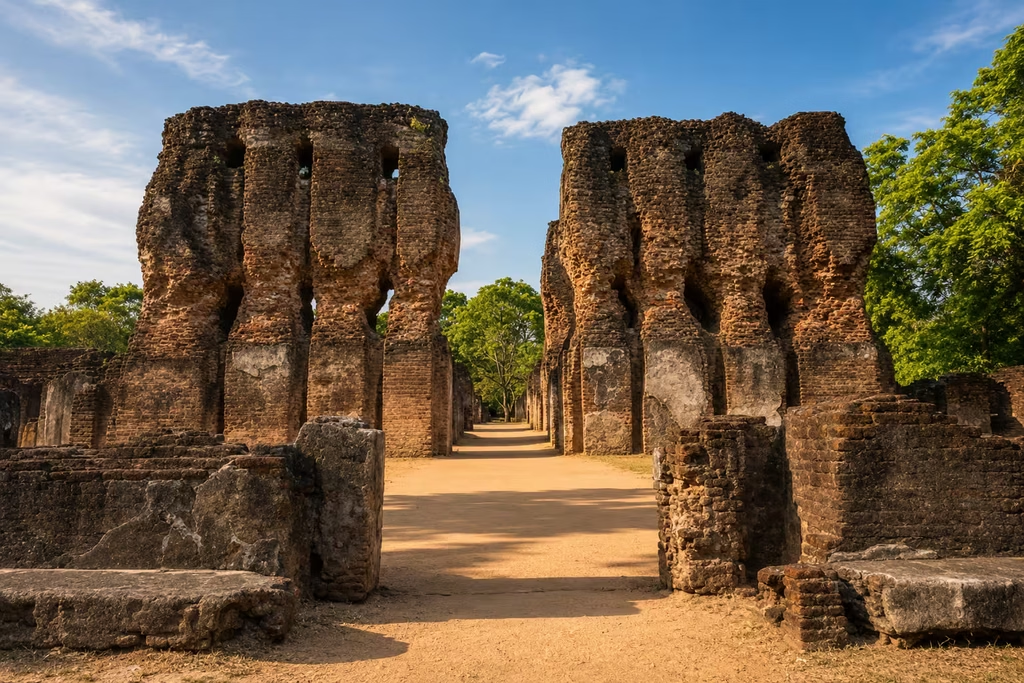
Royal Palace complex
The palace area introduces visitors to the political side of the city. Foundations and surviving walls indicate the scale of royal architecture even though upper levels have disappeared.
A guide or good map helps reconstruct how the buildings functioned.
The Sacred Quadrangle
The Quadrangle contains a dense collection of religious structures within a compact elevated area. It is one of the best places to appreciate Polonnaruwa’s architectural variety.
Move slowly and look at stone carving, shrine forms and the relationship between individual monuments.
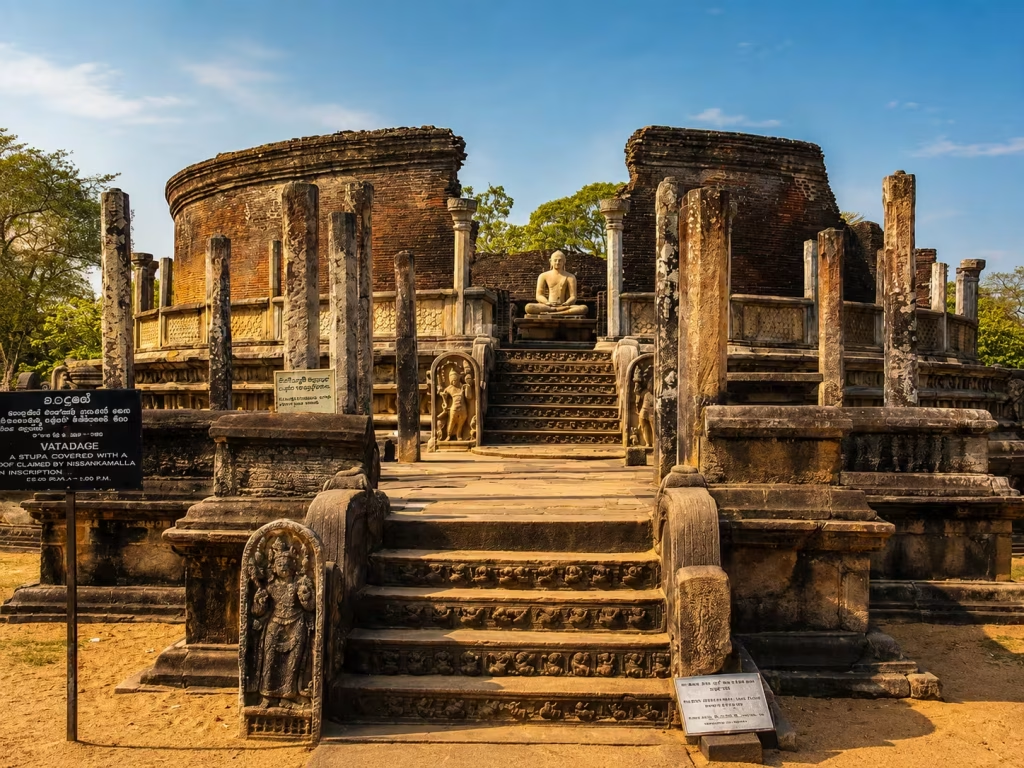
Vatadage
The circular Vatadage is among Polonnaruwa’s most admired structures. Its terraces, guardstones, moonstones and Buddha images demonstrate sophisticated stone craftsmanship.
Follow religious etiquette around Buddha images even though the site is archaeological.
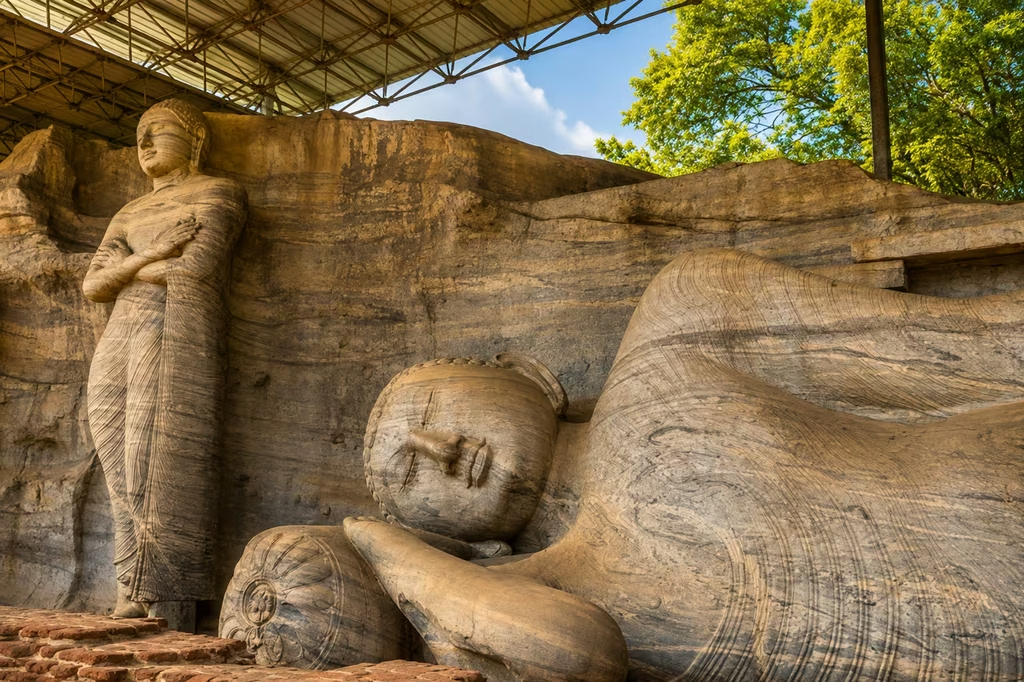
Gal Viharaya
Gal Vihara is one of the most important sculptural sites in Sri Lanka. Large Buddha images were carved directly into a long granite face.
The standing, seated and reclining figures create different devotional moods and should be viewed from more than one angle.
Lankatilaka and larger monastic buildings
Tall brick walls at Lankatilaka show the scale of image houses that once dominated parts of the sacred city.
Do not climb walls or ancient platforms outside designated access.
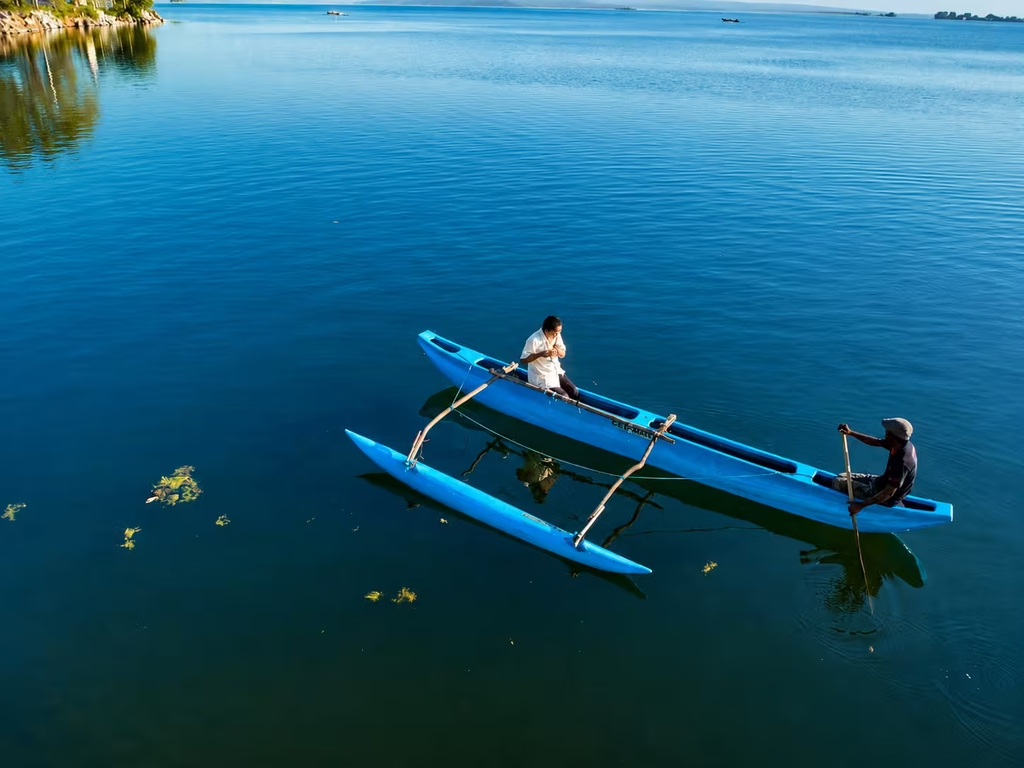
Parakrama Samudra
The vast reservoir associated with Parakramabahu I demonstrates the importance of hydraulic engineering to the medieval capital.
Sunset views can be attractive, but the reservoir should be understood as infrastructure as well as scenery.
Cycling
Bicycles are one of the most enjoyable ways to explore because the terrain is relatively flat and monuments are spread along connected roads.
Use sun protection, carry water and lock your bicycle where appropriate.
Tuk-tuk or vehicle
Travelers who dislike heat or cycling can use a tuk-tuk or vehicle. This is also useful for families and older visitors.
Even with transport, walk selected monument clusters rather than viewing everything from the road.
Temple etiquette
Cover shoulders and knees, remove shoes where required and avoid posing with your back directly toward Buddha images in a disrespectful way.
Archaeological status does not erase the sacred character of Buddhist monuments.
Best time of day
Early morning is cooler and quieter. Midday heat can be intense, particularly on open stone and roads.
A useful plan is to visit major exposed sites early, rest at lunch and return later in the afternoon.
Polonnaruwa Weather: 7-Day Forecast
Updated automatically with the latest available forecast for Polonnaruwa, Sri Lanka.
- Rain chance
- 90%
- Rainfall
- 0.6 mm
- Wind
- 12 km/h
- UV index
- 8.0
- Sunrise
- 5:59 AM
- Sunset
- 5:43 PM
- Rain chance
- 99%
- Rainfall
- 9.5 mm
- Wind
- 11 km/h
- UV index
- 7.1
- Sunrise
- 6:00 AM
- Sunset
- 5:44 PM
- Rain chance
- 99%
- Rainfall
- 5.5 mm
- Wind
- 11 km/h
- UV index
- 7.2
- Sunrise
- 6:00 AM
- Sunset
- 5:44 PM
- Rain chance
- 100%
- Rainfall
- 19.9 mm
- Wind
- 6 km/h
- UV index
- 7.8
- Sunrise
- 6:01 AM
- Sunset
- 5:44 PM
- Rain chance
- 97%
- Rainfall
- 15.6 mm
- Wind
- 8 km/h
- UV index
- 7.8
- Sunrise
- 6:01 AM
- Sunset
- 5:44 PM
- Rain chance
- 88%
- Rainfall
- 9.0 mm
- Wind
- 12 km/h
- UV index
- 7.6
- Sunrise
- 6:02 AM
- Sunset
- 5:44 PM
- Rain chance
- 82%
- Rainfall
- 10.8 mm
- Wind
- 15 km/h
- UV index
- 7.0
- Sunrise
- 6:02 AM
- Sunset
- 5:45 PM
Using the museum before the ruins
If time allows, begin with the archaeological museum. Sculpture, models and interpretation can make the ruins much easier to understand once you enter the ancient city.
Visitors who prefer to see the monuments first can return to the museum afterward and use the displays to clarify architectural details they noticed during the day.
How long should you spend?
A full day is ideal for first-time visitors. Half a day can cover highlights but often feels rushed.
History enthusiasts may prefer two days including the museum and quieter sites.
Combining Polonnaruwa with Minneriya
Polonnaruwa and Minneriya are close enough to combine, but doing the full ancient city and a safari in one day is tiring.
If possible, split them across two days from Habarana, Sigiriya or Polonnaruwa.
Photography
Morning and evening light reveal brick and stone texture. A moderate wide lens suits architecture, while a longer lens can isolate sculpture details.
Respect photography rules around sacred images.
Responsible heritage travel
Do not climb monuments, remove stones or touch fragile carving unnecessarily. Stay within designated paths and use official guides where possible.
Frequently asked questions
Is Polonnaruwa a UNESCO World Heritage Site?
Yes. The Ancient City of Polonnaruwa was inscribed in 1982.
Can I cycle around the ruins?
Yes. Cycling is popular and practical for many visitors.
How long do I need?
Plan a full day for a comfortable first visit.
What should I not miss?
The Royal Palace area, Sacred Quadrangle, Gal Vihara and major monastic monuments are essential highlights.
Final planning advice
Check current access, weather, local regulations and transport shortly before your visit because protected areas, heritage sites and marine activities can change their visitor arrangements. Avoid building a schedule with no margin for delays or unsuitable conditions.
A better Sri Lanka itinerary allows enough time to observe, rest and respond to local advice. Spending longer at one destination generally creates a more meaningful experience than rushing through several places simply to collect photographs.