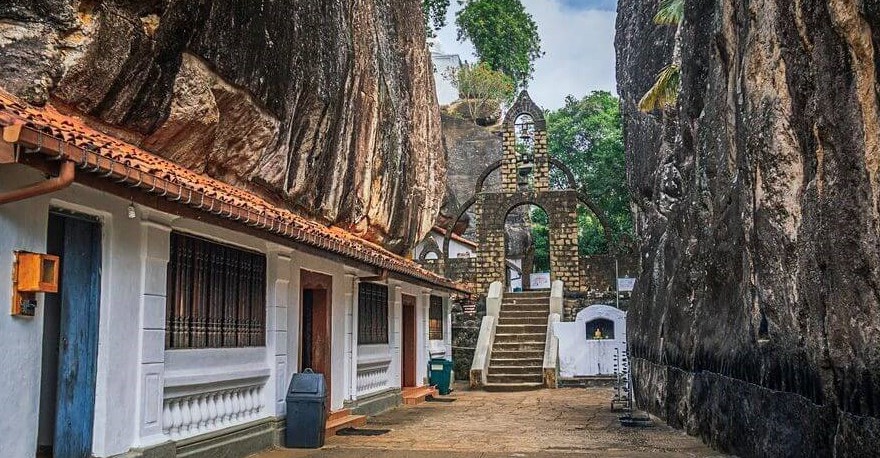
Aluvihara Rock Cave Temple, near Matale in Sri Lanka’s Central Province, is one of the island’s most historically significant Buddhist monasteries. The temple is built among large rock outcrops, but its importance goes far beyond its dramatic setting: Buddhist tradition associates Aluvihara with the first writing down of the Pali Canon, or Tipitaka, on palm leaves.
For travelers interested in religion, literature and ancient Sri Lankan culture, Aluvihara provides a valuable stop between the Cultural Triangle and the central highlands.
Why Aluvihara matters
For generations, Buddhist teachings were preserved through oral recitation. According to the historical tradition maintained at Aluvihara, monks gathered here in the first century BCE, during the reign of King Valagamba, and committed the Tipitaka to writing on palm leaves.
The Tipitaka contains the Vinaya Pitaka, Sutta Pitaka and Abhidhamma Pitaka. The association with their written preservation gives Aluvihara a special place in the history of Theravada Buddhism.
A temple among rocks and caves
The setting is part of the experience. Temple buildings and cave spaces are arranged around large natural rock formations, creating a sequence of enclosed shrines, passages and elevated viewpoints rather than one monumental structure.
Visitors should slow down and notice painted surfaces, Buddha images, rock shelters and the way later religious buildings have been incorporated into the natural terrain.
Palm-leaf manuscripts and the written tradition
Sri Lanka’s palm-leaf manuscript tradition is an important part of the story. Texts were traditionally incised onto prepared leaves, then preserved as bound manuscript sets. At Aluvihara, this material tradition helps connect an abstract idea—the preservation of scripture—with the physical labor of writing, copying and safeguarding religious knowledge.
Displays and interpretation may vary over time, so treat any manuscript or museum presentation as part of the current temple experience rather than assuming every feature will always be available.
Aluvihara Rock Cave Temple Weather: 7-Day Forecast
Updated automatically with the latest available forecast for Matale, Sri Lanka.
- Rain chance
- 4%
- Rainfall
- 0.0 mm
- Wind
- 10 km/h
- UV index
- 8.3
- Sunrise
- 5:59 AM
- Sunset
- 5:45 PM
- Rain chance
- 43%
- Rainfall
- 0.2 mm
- Wind
- 10 km/h
- UV index
- 7.9
- Sunrise
- 6:00 AM
- Sunset
- 5:45 PM
- Rain chance
- 80%
- Rainfall
- 14.7 mm
- Wind
- 9 km/h
- UV index
- 7.7
- Sunrise
- 6:00 AM
- Sunset
- 5:46 PM
- Rain chance
- 72%
- Rainfall
- 0.6 mm
- Wind
- 9 km/h
- UV index
- 8.2
- Sunrise
- 6:01 AM
- Sunset
- 5:46 PM
- Rain chance
- 93%
- Rainfall
- 15.3 mm
- Wind
- 6 km/h
- UV index
- 8.1
- Sunrise
- 6:01 AM
- Sunset
- 5:46 PM
- Rain chance
- 100%
- Rainfall
- 80.7 mm
- Wind
- 8 km/h
- UV index
- 7.9
- Sunrise
- 6:01 AM
- Sunset
- 5:46 PM
- Rain chance
- 100%
- Rainfall
- 43.2 mm
- Wind
- 10 km/h
- UV index
- 1.7
- Sunrise
- 6:02 AM
- Sunset
- 5:46 PM
Planning a visit from Matale
Aluvihara is close to Matale and can fit naturally into journeys between Kandy, Dambulla and the Cultural Triangle. The temple can be visited as a focused heritage stop or paired with other attractions in the Matale area.
Because the complex includes steps and uneven surfaces around rock formations, comfortable footwear is helpful. Sri Lanka’s tropical heat and sudden rain can also make stone surfaces slippery.
Respectful temple etiquette
Aluvihara is an active Buddhist place of worship. Cover shoulders and knees, remove footwear where indicated, keep voices low and avoid interrupting worshippers or ceremonies.
Photography rules may differ between shrine areas. Ask before photographing monks, religious ceremonies, manuscripts or sensitive interior spaces. Avoid turning your back to a Buddha image for a posed photograph if local guidance indicates that this would be disrespectful.
Who will enjoy Aluvihara most?
The temple is especially rewarding for travelers interested in Buddhist history, manuscript culture, cave temples and quieter heritage sites. It also provides context for visits to larger monuments at Anuradhapura, Polonnaruwa and Dambulla by showing another side of Sri Lanka’s religious history.
The preservation of the Tipitaka and why that story matters
The central historical tradition associated with Aluvihara concerns a moment when oral preservation was considered vulnerable. Buddhist teachings had been transmitted through disciplined memorization and recitation by generations of monks. According to Sri Lankan tradition, political instability and difficult conditions created concern that parts of this inherited body of knowledge might be lost. Writing the teachings on palm leaves therefore represented an important act of preservation.
The event is significant even for visitors who are not Buddhist. It offers a window into how knowledge survived before printing and digital storage. Every manuscript required prepared leaves, careful handwriting or incision, trained readers and continued copying as materials aged. A sacred text was not preserved once and then forgotten; preservation depended on communities repeatedly maintaining it.
What are the three parts of the Tipitaka?
The Pali Canon is traditionally divided into three major collections. The Vinaya Pitaka concerns monastic discipline and the organization of religious life. The Sutta Pitaka contains discourses and teachings, while the Abhidhamma Pitaka presents systematic analytical treatments of Buddhist doctrine. Visitors do not need to study these texts in advance, but knowing the basic structure helps explain why the Aluvihara tradition is so important within Theravada Buddhism.
How palm-leaf manuscripts were made
Palm-leaf manuscripts are a physical craft as much as a literary tradition. Suitable leaves had to be selected, processed, dried and cut to shape. Text was traditionally incised with a stylus rather than written with an ordinary modern pen. Pigment could then be rubbed into the incisions to make the characters visible. Individual leaves were pierced and held together between protective covers.
This process explains why manuscript culture required specialized knowledge. Heat, humidity, insects and handling could damage the material, so copying and conservation were continuing responsibilities. At Aluvihara, the association between scripture and palm-leaf technology gives visitors a tangible way to understand the effort involved in preserving religious literature over centuries.
Exploring the caves and rock setting
The temple’s boulder landscape creates an experience very different from a large stupa complex. Instead of one open monumental space, visitors move through smaller shrines and cave interiors where rock, architecture, painting and sculpture meet. Changes in light can be dramatic: bright tropical sun outside gives way to darker devotional spaces within the caves.
Take time to let your eyes adjust before photographing or moving quickly through an interior. Murals and images are best appreciated quietly, and some areas may have photography restrictions. The caves are religious spaces rather than museum rooms, so worshippers should always be given priority.
Aluvihara in a Matale itinerary
Its location near Matale makes Aluvihara convenient for travelers moving between Kandy and Dambulla. That does not mean it should be treated as a ten-minute roadside stop. Allow enough time to climb steps, explore the caves and understand the manuscript tradition. Combining the temple with Matale’s townscape, spice-growing region or onward travel toward Dambulla can produce a balanced day without excessive backtracking.
If you are travelling with an older visitor or someone with reduced mobility, ask locally about the number of steps and which sections are easiest to access. The rock setting naturally creates changes in level that may not be obvious from photographs.
How to behave at a living Buddhist temple
Modest clothing is appropriate, with shoulders and knees covered. Shoes and hats may need to be removed before entering sacred areas. Avoid turning your back directly toward a Buddha image for a posed photograph, and never climb onto altars, statues or historic surfaces. Speak quietly around people who are praying or making offerings.
Small cultural courtesies improve the experience. If you are unsure whether a space can be entered or photographed, ask. Visitors are generally welcomed, but respectful curiosity is very different from treating the temple as a theatrical backdrop.
Why Aluvihara rewards a thoughtful visit
Aluvihara connects several themes that define Sri Lankan heritage: Buddhism, literacy, monastic scholarship, rock-temple architecture and the long effort required to preserve knowledge. The site is not as physically vast as Anuradhapura or as visually dominant as Sigiriya, but its intellectual significance is exceptional. Travelers who understand the story before entering the caves are likely to leave with a much stronger impression.
Frequently asked questions
What is Aluvihara famous for?
It is traditionally associated with the first writing down of the Buddhist Tipitaka on palm leaves in the first century BCE.
Is Aluvihara an archaeological ruin?
It contains historic cave and temple features, but it is also a living Buddhist religious site.
Can I visit Aluvihara on the way to Dambulla?
It is near Matale and can be incorporated into a road journey through central Sri Lanka, depending on your route and available time.